By Carol Tice
I spend a lot of my time encouraging freelance writers to strive for better pay. But what about when you don’t have that luxury?
I had one writer ask me recently:
What if I’m desperate for work? What do you do when you just need money so bad — right now?
In today’s market of low-paying mills and bidding-site gigs, it’s easy to get trapped in a cycle of taking low-paying gigs that never seem to quite cover the bills, no matter how many hours you work.
You’re stuck. It’s hard to ever move up and earn more. You’re spending a decent amount of your time worrying about whether you can keep a roof over your head and food in the fridge.
Here are five strategies to think about when you feel the panic rising and you’re starting to feel desperate:
1. Cut your expenses. If you haven’t lately, track every dime you spend for a month. See if you can’t find places to cut back your spending. Less spending can buy you breathing room and the freedom to say no to low-paying gigs and to hold out for better ones.
2. Start saving money. Freelancers need an emergency account — or at least access to credit — that can help tide them over if they hit a bad month. Then, when you’re slow, you can market harder instead of biting your nails about whether you’ll be able to pay your bills.
3. Cold call some local businesses. If you have even one spare hour, you can pick up the phone, call local businesses, and ask them if they need a copywriter. I have yet to meet anyone who’s done a serious round of cold calls and not found at least one client.
4. Work your accounts receivable. Do clients owe you money? Send a few polite emails or make a few calls and see if you can get them to send that check already. Or better yet, negotiate better terms for the future — net 15 instead of net 45, or direct deposit today instead of a check in the mail in 10 days. Often, what broke freelance writers have really isn’t an income problem but more of a cash-flow problem. Don’t fall into what I call the “bank of Carol” trap, and let clients run their businesses on what they owe you.
5. Take a side job. It may be that you’ve fallen so far behind financially that the only way out is to get an hourly wage job you can count on to add some income, so you can rebuild your finances. I know writers who’ve done medical transcribing or stocked grocery shelves at night to pay bills while they got established as freelance writers. Personally, I typed movie scripts. Ideally, the job doesn’t take too many hours and still leaves some time to pursue freelance writing.
6. Learn more. If you haven’t been able to move up as a freelance writer, consider taking a class and learning more about how to succeed in the business of freelance writing. I know — you feel broke. But the problem is, you may always feel broke if you don’t acquire more knowledge of how to move up to good-paying markets.
I’ve talked to a lot of freelance writers who seem to think this is a “no overhead” business, where you don’t have to spend any money to operate successfully.
But it’s a myth.
Freelance writing is like any other line of work — investing in your professional development can pay huge dividends in increased earnings.
 By Stefanie Flaxman
Have you ever thought about adding proofreading services to your repertoire?
One of the smartest things that you can do for your freelance business is diversify. If you’re a writer who has a knack for catching errors, put it to use.
Yes, Little Miss Aspiring Carrie Bradshaw, I know this sounds depressing. Your writer-life fantasy probably includes contemplation in a cozy office that smells of rich mahogany, followed by a ritualistic sipping of five-dollar lattes as captivating words waltz from your fingertips onto your keyboard.
By now you should know that a freelance writing career is no fairy tale. Marketing and expanding your services are always part of the mix.
Here are five tips to help you increase your income by offering proofreading services.
1. Impress your current clients.
Chances are that you don’t write all of the copy that an existing client produces. Browse Web content that you didn’t write, and make suggestions for improvement—you even may spot a glaring error.
Does the client need some writing just proofread? You can do that! After you’ve demonstrated your meticulous editing ability, the client may assign you more writing gigs.
2. Charge per word.
Metro PCS advertises that the total price of a wireless telephone plan includes all taxes and fees. Their slogan is “Not $40-ish. 40.” I dig the “no surprises for the customer” attitude.
Figure out an appropriate per-word charge depending on how fast you work. A client can quickly determine her fee with this model.
I offer three levels of proofreading services ranging from $0.01 to $0.02 per word. Since I specialize in fast turnaround for small business documents, I also charge an additional fee for turnaround time. Clients calculate cost with the formula, “total fee = (proofreading service fee + turnaround time fee) x word count.”
3. Use PayPal.
People trust PayPal, and the established payment transaction company helps you address a prospect’s fear of giving you her hard-earned money in exchange for services. Let a potential client know that you understand this apprehension by making a refund (if warranted) simple.
4. Meet deadlines.
I recently edited a 160,000-word novel and returned it by my deadline. An email reply from my client read, “Thank you very much for being the first person to get the book back to me by the time you said you would.”
I would never miss a deadline, but tardiness is common and oftentimes tolerated. Stand out by demonstrating punctuality.
Also, when a client wants a piece of writing edited, it is essentially perfect from her perspective (no matter how many mistakes you do find). Don’t make her wait for the final product.
5. Love it. Live it.
Find clients with complementary personality types and writing styles to create a powerful team.
I love working with writers. The best editors passionately enhance and perfect raw copy with an intuitive sensibility. The collaboration makes the writer’s intentions shine.
Although the writer is the “star,” consider “behind the scenes” work to contribute to the writing process, utilize your proofreading skills, and boost your freelance income.
Stefanie Flaxman corrects business, marketing, and educational documents in 24 hours. She’s a professional proofreader and the founder of Revision Fairy® Small Business Proofreading Services. Connect with Stefanie on Twitter.
 By Carol Tice
For anyone who hasn’t been following along, Demand Media — owner of popular content mill Demand Studios — finally went public last week and netted about $77 million, after many months of seeking buy-in from investors.
The company’s business model raised quite a few eyebrows, especially its lack of profit despite many public claims to the contrary, heavy reliance on Google to drive traffic to its sites, and dubious accounting method in which they amortize your measly $15 writer fee across five years.
But the deed is done now, and Demand is a publicly traded company, at a valuation that for a brief moment there was, surreally, greater than that of the New York Times.
What does Demand’s IPO mean for freelance writers?
Let’s put it this way: I’m not buying their stock. And if I were writing for Demand, I’d be planning my exit strategy.
Harsh scrutiny hits Demand
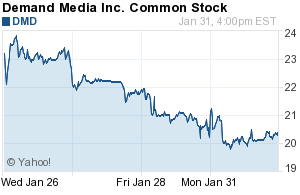
I wanted to wait a week and see what happened with their stock price before I wrote about Demand again, to watch investors’ reactions. So here’s what it did: After a brief bump up — it priced at $17 a share, above its planned range — Demand stock has gone nowhere but down, as you can see in the chart at right.
Why is that happening? Skepticism has already set in within the investment community. For instance, at the influential investor blog Seeking Alpha, Kevin Berk suggested the company’s true value is more like $10 a share and strongly recommended investors sell it. Popular personal-investing site The Motley Fool named Demand “the market’s best short opportunity” — meaning investors could profit by purchasing options that essentially bet the stock’s value will decline.
It probably didn’t help that nearly the moment Demand went public, Google announced changes to its algorithm to crack down on spammy, plagiarizing sites. Demand said that wouldn’t affect it…until oops! It acknowledged maybe its sites do have a plagiarizing problem.
They’ve said they’re going to work on fixing that. Really. More Google changes are expected, and they could drastically affect Demand’s ability to draw viewers to their sites.
I think going public isn’t going to work out well for Demand, or for its writers.
As some observers have pointed out, Demand flourished in part because a lot of people were out of work and desperate, willing to work for a few quick bucks. Now, the economy is recovering, and soon the unemployment rate will likely begin to decline.
It’s unclear how Demand will continue growing and get big enough to become profitable under this scenario. It’s a bit of a mystery why it’s not profitable already, given what they pay writers and editors versus what Demand makes.
What it means for Demand writers
I think writers who depend on Demand for income should pay close attention to what’s happening here. Professional investors — people who analyze companies’ prospects for a living — are betting against Demand. They’re not seeing a profitable business model in here.
It’s worth noting that Demand’s IPO hasn’t paid off its debts. Far from it — it’s raised more than $300 million in venture capital. The IPO has bought it only modest breathing room.
Translation: Don’t expect a rate raise. As Demand’s stock declines, the company’s value shrinks and its ability to borrow will shrink, too, limiting the company’s ability to spend for growth.
Now that it’s public, Demand will be under more pressure than ever to squeeze out costs. If anything, pay rates will likely only go down — that is, if Google doesn’t pull a shift that vaporizes Demand’s whole business model. Google is under its own pressure, from competitors such as Blekko, which is already filtering out junk-content sites such as Demand’s.
Demand Studios may soon find its new-media empire is built on sand that could shift or blow away. Here’s hoping Demand’s 17,000 freelancers are ready for the changes.
 By Carol Tice
I often have freelance writers tell me they don’t think writing query letters is worth the effort. They get a lot of rejections, and feel it’s basically a crapshoot…and so much easier to sign on to a content-mill dashboard for a guaranteed few bucks’ worth of work.
It’s true that querying isn’t a sure thing. But if you take the time to learn this skill, it can really help you move up and earn big.
I regularly get lucrative assignments off of query letters, and I continue to believe querying is a vital skill for successful freelancers. With so many writers turned off of queries, taking the time to learn how to write a compelling query letter is well worth the effort, as it makes you stand out in today’s marketplace. Querying can open doors when you don’t know anyone at a publication or company, and make a connection that could turn into an ongoing relationship.
For instance: I recently sent one query letter that got me $6,000 of assignments. This query used one of my favorite strategies: Multipitch, or the technique of sending two or three story ideas in a single, one-page query letter.
Multipitch sort of reminds me of the multiball feature on old pinball machines. If you’re old enough to remember these, you’d load more than one ball onto the board, and then if you could hit it right, you’d get them all to activate and start scoring you points at once, multiplying your score.
Multipitch in queries is like that, as it multiplies the impact of your letter — and also multiplies your possible earnings. Submitting more than one story idea shows:
So here’s the part about this query win that really had me elated: When I sent in my pitch, I was told this outlet had never accepted an outside query before. All the story angles had up to that point been developed by the editor!
Instead of discouraging me, hearing that only made me more motivated to deliver strong pitches. I was hoping maybe one of my three ideas would make the grade.
I about fell over when the editor let me know all three pitches had been accepted, for a total of $6,000 in assignments.
I’ve never done this on the blog before…but since this was my most lucrative single query letter ever, I decided it would be useful for readers to see exactly what this query letter looked like. So I’m reproducing my pitch below.
This pitch went to a major company that operates several business-information websites. The site I targeted publishes well-researched, 1,000-word articles. Pay is $2,000 per article. I initially reached out to the editor on Twitter and asked if it would be OK to pitch her.
To avoid having my editor inundated with queries, I have omitted some identifying details about this market and the sources I proposed.
This is what I sent the editor:
Dear [editor’s name]:
As I mentioned on Twitter, I am a longtime business writer with expertise in finance. Here are three ideas I think might be a fit for your site:
1)Why Now’s the Time for a Sale/Leaseback Deal – Conditions are ripe for companies to liberate cash by selling property and leasing it back. Known as “net leasing,” these deals can fund growth without a company having to seek bank or investor funding. Whether a company owns an office building, warehouse, or retail stores, net leasing allows it to operate in the same facility with a long-term lease and assurance there’ll be no disruption to operations. Another plus: sale/leasebacks get companies out of the property-ownership game and back to focusing on their core business. Net-lease is booming this year as companies are strapped for cash and investors like the guaranteed tenant that comes with the deal. For this story, I would interview several company finance managers who have recently done sale/leasebacks, as well as commercial-realtor experts and [source name], an online exchange for commercial property that company owners are looking to sell and lease back.
2) To Save More, Send Your Workers Home – A recent study from [well-known research house] shows mid-sized companies can save $11,000 per worker by letting them work from home just half-time. Telecommuting has other benefits as well, including reduced absenteeism and increased productivity on work-from-home days, according to the report. That’s $1.1 million in savings for a company that puts 100 workers on part-time telecommuting schedules. With Congress passing legislation requiring more home-based work by government-agency employees, it’s a great time to examine how telecommuting can help businesses save money. For this story, I would talk to experts and business owners who’ve implement telework programs to glean best practices for making it work.
3) Starting a Joint Venture? Plan for Its End – Joint ventures often start with the best intentions, but a few years down the road, one or both parties may determine the partnership isn’t working. That’s when things can get sticky — unless the original agreement included careful planning for how the joint venture would be dissolved. For this story on how to structure a prudent joint venture agreement, I would speak with company finance executives who’ve been involved in recent JV partnerships that needed to be unwound, including one where planning was good and the process was fairly straightforward — and one where the agreement didn’t contemplate the breakup and problems were encountered. I’d also get recommendations from well-known business attorney [source name] on how to structure these deals. Readers would come away with concrete information on how to structure partnerships to protect their interests and prevent costly litigation or loss of vital assets created in the partnership.
My work has appeared in Entrepreneur magazine, Washington CEO, The Seattle Times and many other publications. You can view recent clips and my list of awards won at http://www.caroltice.com.
Thanks in advance for considering my query.
Enjoy!
–Carol Tice
I’d say one key element that helped this query succeed — which I often don’t see present in many queries I’ve reviewed — is the research into the topic and citing of possible experts. Editors tell me many queries seem lazy — they propose a vague idea without laying out a clear road map of who would be quoted and what information the story would contain. Including those specifics made this query stand out for my editor.
Final note: You’ll notice I have an unusual signoff. I believe developing a creative conclusion for your queries can help you stand out and get noticed.

By Stephanie Mojica
I’m not one to knock legitimate writing opportunities. And yes, those “content mills” like Demand Media Studios, Bright Hub, and Break Studios will pay you on time for rather formulaic writing work.
But what if you’re a slow writer, don’t believe in content mills, or are simply sick of churning out article after article?
What if you have some great writing samples (either print or online) and are ready to focus on quality rather than quantity while earning the money you truly deserve?
Job bidding sites like Guru and oDesk have given me even more economic and creative opportunities than mills, especially as a blogger and book editor. It literally is like an eBay for writers and all types of work-from-home professionals.
I have garnered numerous clients on bidding sites for press release writing, environmental blog writing, horoscope writing, financial blog writing, divorce blog writing, book editing, and publicity campaigns.
Like any site, once you learn the system you can and will succeed. If you take the right action steps, it’s not a matter of if you will succeed but when.
Good rates are possible on the bidding sites. I have consistently made at least $90 an hour and usually $150 to $300 an hour devoting my time to writing clients I’ve found on Guru.
If you have a resume and a few writing clips to show potential clients, you can do the same. My tips:
Bid only on jobs that pay what you’re worth. This is extremely important. So many writers give in to deprivation thinking. Twelve-step groups like Underearners Anonymous, Debtors Anonymous, and Workaholics Anonymous are full of writers with financial problems. Believe me, I personally know this. Part of the problem is that so many writers think it’s not “spiritual” or “creative” to ask for a great wage, I eventually discovered through working with author and life coach Sheri Kaye Hoff.
Set a goal of how many bids you will make per day. It’s a sheer numbers game, my friend. The more bids you get out there — especially at first when you have little or no client feedback posted online — the better you will do.
I’ve competed for jobs listed in online ads with 1,000 people. On Guru and oDesk, I’ve often been the only bidder or one out of three, five, six, 10, or 20. I’ve seen projects that I haven’t bid on with identical odds.
I wish you the best of luck in your journey to financial freedom and creative prosperity.
Stephanie Mojica, a writing and business prosperity coach, blogs at “Hot Freelance Writing Secrets” and is the author of several eBooks including“5 Business Prosperity Secrets.” Her credits include The Philadelphia Inquirer, The Virginian-Pilot, Louisville Magazine, USAToday.com, and SFGate.com.
By Carol Tice
Many freelance writers are afraid of taking the plunge into freelance writing. But there is something that’s even scarier.
It’s having a job.
Workplace experts have been watching how employers hire workers since the downturn began in 2008. Here’s their conclusion: Roles like writing are going to be done freelance in the future. Many of those jobs aren’t coming back as full-time gigs.
Freelancing is the new normal for writers.
While struggling to survive the downturn, many companies tried outsourcing. They liked it. Websites such as oDesk and Elance have made it easier to connect with freelancers, monitor their work, and pay them reasonable rates (or rock-bottom ones). This accelerated a trend that pretty much began the minute the Internet was invented. The fact is, tools exist now to make working remotely easy — Skype, Basecamp, email, PDFs, videoconferencing…it all makes it easy to plug use freelancers.
I spoke recently with a small-business expert, Steve King at Emergent Research. His firm’s estimate? Currently, 25 percent of design/writing/coding type jobs are being done freelance.
By 2020, Emergent expects that figure to rise to 50 percent. That’s right — half of all the writing work will be done freelance, soon. Or, put another way: Twice as much freelance work will be available a decade from now.
If you’re wondering, King considers Emergent’s estimates conservative. Other industry pundits have forecast 75 percent of creative jobs being done freelance in future.
Which is really riskier?
Since 2008, I’ve watched friends of mine lose their jobs, get divorced, go bankrupt, have heart attacks from the stress, and lose their homes.
Having all your income tied up to a single employer, we’ve learned, is actually very risky. That gives one company the power to devastate your family and destroy your lifestyle, overnight.
Finding another single, big fat job to replace the one you lost could take years, or may never happen. People who don’t know how to survive without sucking off the teat of Big Momma Corporation are facing radical changes in their quality of life.
By contrast, during the downturn, every editor I worked for either left or was fired from their job. All my gigs shifted around. But not all at the same time. I kept finding new clients to replace the old ones, because I’d learned how to market myself. Result: I lost gigs, but my income kept rising.
My family life remained stable. I’m still living in the same house, eating out, sending my kids to camp, and putting away money for retirement.
After 12 years in staff-writing jobs, and now five as a freelancer, I can say I feel far more secure now than I did when I got only one paycheck instead of many smaller ones. I feel secure because I know how to find assignments now, no matter what.
Also, my earning potential is unlimited, where at a job it was always capped at my salary. Maybe I could squeeze out a tiny raise each year, but that was it.
Still think freelancing is too scary? Here’s the reality:
Freelancing is the future.
The longer you hang on, fantasizing that things will go back the way they were, the more of a disadvantage you create for yourself in the marketplace. If you’re not freelancing now, you’re not out learning the vital entrepreneurial skills you will need to earn well in the years to come — skills like how to market and manage your freelance writing business.
I believe there’s never been a better time to learn how to be a successful freelancer. By getting started now, you’ll position yourself to gain experience, while many others are still clinging to their day jobs. You’ll be more established when more writers get laid off, and are scrambling to catch up.
By Alan Kravitz
By now, pretty much the entire planet has heard the story of Ted Williams, who, in a matter of days, went from Homeless in Ohio to Media Sensation Everywhere.
He’s The Man With the Golden Voice. The New Susan Boyle. Don’t be surprised if he starts dating one of the Kardashian sisters.
Though we’re just days into the new year, it’s going to be mighty hard to top this as the Feel Good Story of 2011. I have to admit, I’m addicted to it.
Why? Well, I like happy endings as much as anyone. But there’s more to it than that.
I’ve been freelancing for six years now. Thank goodness, I’ve never been as down on my luck as Ted was. Still, I’ve hit some rocky patches. I used to get by on my reputation alone.
In the past year, I’ve learned the hard way that I must market myself like crazy. That’s why I think Ted’s story holds valuable lessons for us freelancers, such as:
1) Be optimistic. Yes, it is true – dire situations are not permanent. I still have periods where I think I’ll never get another writing assignment. Still, I don’t give up. Neither should you.
2) Be sure of your talent. Ted did more than hold up a sign on the side of the road – he let people know what he could do. That’s what piqued the videographer’s interest (“Hey, let’s hear that voice”) – and the rest is history. We can’t afford hide our own God-given talents. We need to, as the Sondheim song says, “Bump it like a trumpet.”
3) Be confident in your abilities. When the videographer asked Ted to speak for the camera, Ted didn’t flinch. He just went for it. Freelancers must always be prepared to demonstrate talent on a moment’s notice, but it’s hard to do that without confidence.
4) Be visionary. Certainly, Ted wants an announcer’s job, but he wants more than that. A music lover, he really wants a job in music radio or broadcasting. As freelancers, we must have a vision. Otherwise, we can fall into the “I’ll take anything” trap. Which leads me to:
5) Be picky – even in tough times. Here’s what impresses me most about Ted. He could easily just grab at the tons of offers coming his way, but he doesn’t seem to be doing that. He’s not taking anything that doesn’t feel right to him. As freelancers, we must be true to ourselves. Taking a gig that’s not a good fit – even for the money – almost never leads to anything positive.
Alan Kravitz is a freelancer copywriter and editor at The Infinite Inkwell. He helps nonprofit and socially conscious for-profit organizations with their writing needs.
By Carol Tice
What’s holding you back from jumping into freelance writing? If my blog readers are any indication, there seems to be one common reason:
Melissa: “I am terrified. Of succeeding, of failing, of just simply doing!”
Kifayat: “Fear of getting things wrong and also selling myself short.”
Cindy: “I fear looking like a fool.”
DeAnn: “I just don’t want to start out on the wrong foot and jeopardize my career before it really gets going.”
Jane: “The idea of succeeding (or even testing myself) too quickly just scares the living hell out of me. Without faithful cheerleaders freelancing success is just too scary (because the bigger success the bigger the failure that might follow).”
To sum up: Many of you are afraid of doing something so awful that it will ruin your freelance writing career.
So today, we will confront these fears. I’m going to tell you something shattering:
I know because I’ve been writing for a living for a long time. I’ve experienced each and every one of the things you are afraid of! Let’s review:
Looking like a fool: I can’t even pick my favorite example of embarrassing gaffes I’ve made. Maybe the time I misspelled “Requiem” in a 48-point, front-page obituary of a prominent citizen.
Getting it wrong: How about the time I said flat-out inaccurate things after a PR person misled me about whether a company would comment for my story? And that company was actually also a prominent advertiser in the publication and the CEO was a personal friend of the publisher?
Failing: I better not look over at my teetering pile of rejection queries — from Parade, Parents, Inc., and on and on. Or over at the article I wrote recently for a Fortune 500 client that was so far off the mark they never used it, and I had to start over from scratch.
Putting the wrong foot forward: Maybe I should mention the time I was interviewing a freakin’ movie star, and made a little jokey reference to schmooze him up…that turned out to be about a different actor’s movie! Or perhaps we might revisit the second article I ever wrote — which I spent weeks on, and it got killed, and I never wrote for that publication again.
Feeling scared: Hello, I am a college dropout! I walked around with a massive insecurity complex for years. I kept waiting for someone to tap me on the shoulder and tell me I wasn’t qualified to be a freelance writer, and that I had been officially placed on the Top-Secret List of Bad Writers whom no one would ever hire.
Succeeding too fast: About nine months after I switched from songwriting to reporting, I was writing cover features for a section of the Los Angeles Times! I was so petrified that it took me about two months to write each article. I felt in way, way over my head.
Why am I telling you all this?
So, now you know. I am a major screwup. I’ve made a massive pile of mistakes. I’ve failed to get a lot of freelance gigs I really wanted.
But I still feed my family of five with my little brain and my little stories. Full time. Freelancing for five years now, making more money each and every year. I have the sense I’m a pretty successful freelance writer.
How is that possible? Because if you persist — if you make up your mind that you are going to make your living from writing, no matter what — you will succeed. You will make mistakes, but they will not ruin your chances. You will still have a freelance writing career.
Every editor in America does not know every other editor. Same with marketing departments at companies. There is always a new market to try, always green fields to explore.
I could cite example after example of writers who have failed their way up to prominent editorial positions. Or look at Henry Blodget, who became known originally as a high-flying, dot-com-era stock trader — who turned out, famously, to be a complete liar who was banned from the securities industry. Now he is a successful, popular blogger for Business Insider.
The lesson: People have short memories. They forgive, and they forget. They wrap fish in yesterday’s paper, the world moves on, and you get a fresh chance. You build a mountain of articles, and if they’re mostly good, you’ll have a good reputation.
The fact is, every writer makes mistakes. If you write in any volume, you will screw up. It’s unavoidable. The odds will simply catch up with you.
After one factoid debacle in a story I wrote years back, I was just morose. My editor noticed me moping around the newsroom, and said this: “You know, you’ve published about 500 articles here. One of them had a serious error. I think that’s a pretty good track record.”
And he’s right. No one will expect perfection from you.
There is really only one way to ruin your freelance writing career. I believe it will not be a problem for any of you who expressed such fear of failure.
Here’s what it is:
Write a factual, reported story in which you simply make things up.
There have been a few cases of reporters who did this over the years. One of the most notorious is Janet Cooke, who won a Pulitzer for a story she made up about a gradeschool-age heroin addict. Another is Jayson Blair, the former New York Times reporter who, it was discovered, fabricated many of his stories.
These people’s writing careers are over. They ruined their careers with their lies.
So that’s it. Now you know what you have to do to keep the doors of success open for you. Just be honest, and don’t make stuff up. Keep writing, learning, and trying your best.
By Carol Tice
It happens to nearly every freelance writer at some point. You have a client, and you want to get rid of them.
They don’t pay enough, or their people aren’t appreciative, or their deadlines are too crazy, or all three. Maybe things started out great, but now the situation has changed. You find yourself putting off their work and maybe not doing the best work you possibly could on their account.
The bottom line: This client has got to go.
Making the decision to drop a client is a positive step. It signifies that you value your time and your career, and are only going to associate with clients that treat you right. It’s an empowering moment, really, when you have the insight that you want to drop a client.
But it can also feel very scary. Maybe you fear the economic uncertainty, or you just hate confrontations.
This topic has been on my mind lately because I recently dropped two steady clients. Here is how I decided these clients needed to be pruned off my roster, and how I handled the situation.
Choosing which clients to drop
In looking at my 2010 earnings, I identified two clients that needed to be cut from my list. I felt strongly that if I dropped these two clients, I would be able to replace them with better clients. I also needed to free up more time to work on this blog.
One client had been a great, steady account for a couple of years, with a nice editor who loved my work and gave me usually two articles a month. The articles appeared on very popular Web sites and gave me some great visibility. But the sad fact was their pay rate was lower than anyone else on my roster, and I didn’t find I got a lot of referrals from the stories. (One of my metrics of whether a client’s work is worth it is whether their clips generate referral business.) I asked for a raise for 2011 and they said they couldn’t do it.
The other was a steady gig with much good about it — a wonderful editor, a cool virtual chat room with all the other excellent reporters, a major brand behind it, huge website traffic, and a chance to learn tons about blogging. But it also had significant negatives, including a crushing monthly workload that had to be met or pay was zero. And its per-blog-post rate was my absolute lowest. It also did not generate referrals, and would have required significant additional time to build income — time I don’t have.
Often, we cling to existing freelance writing clients because it’s comfortable. We know what’s expected of us. It’s a known quantity. It feels secure.
But the reality is that if we don’t keep improving our client list, our income won’t grow. I eventually realized it was time for me to make some changes, which you want to do before the quality of what you’re delivering starts to go downhill.
Once you’ve decided a client is getting the ax, the trick is to do it in the best possible way. Here are my tips for managing the process of saying goodbye to a client:
My dream with the second client I dropped was to get more casual, better-paying occasional freelance gigs from them instead of being part of their monthly grind. I was classy, gave lots of notice, made sure my editor knew how much I valued working with him…and mentioned that I was available for any special projects.
Presto: Since exiting my regular gig, I’ve gotten several fun, easy blog assignments and made over $2,000, with the potential for more work to come.
Sending a snarky farewell email or slamming out your editor’s door may feel good for a moment, but it burns a bridge. Better to keep all your options open for the future.
By Carol Tice
Most freelance writers don’t target many of the best-paying client types in their marketing.
Most of these gigs aren’t as sexy as a cover feature for a glossy newsstand magazine, which is where many freelancers aim their queries. Or writers are stuck writing for mills or small businesses, neither of which will ever grow into a high-paying situation. But if you can get your head around the idea of taking challenging assignments that offer less glory but great paychecks, there are many possibilities.
Despite what you hear on many writers’ chat forums, there are still many, many publications and companies that pay professional rates. Why is that? Why don’t they just put their article needs on a bidding site and get them done for $20 apiece by some guy in Bangladesh?
Maybe they would if they could, but they can’t. That’s because the articles, blogs, case studies, and Web content they need written require a real pro — usually, someone with a specialized set of skills or knowledge.
What are those skills? Some of the assignments I find pay best require an ability to:
Now that you understand some of the skills that help elevate your writing to a higher pay grade, let me describe some of the less-well-known client types that tend to pay well:


